What Is Cloud Computing in Healthcare? A Guide for Clinics & Hospitals
As a clinic owner, you will have heard the term “move to the cloud” from every software vendor that has ever phoned your practice. It gets used so loosely that it’s almost ...
Start your 90 day free trial – All Features, Zero Cost – No Credit Card Required
Share Article
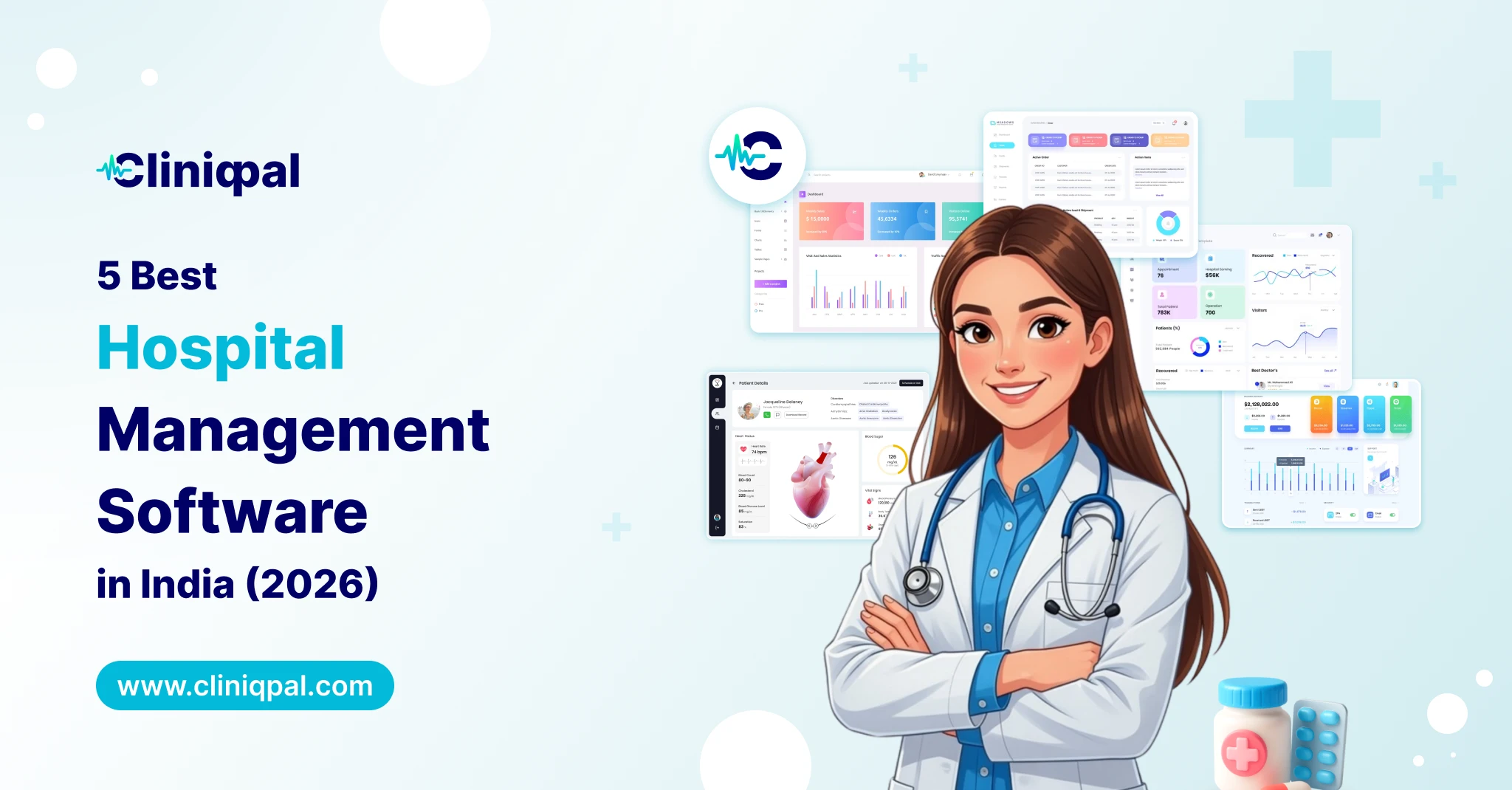
Operating a hospital or clinic in India nowadays entails balancing much more than the provision of patient care. You have to do billing, you have appointment scheduling, staff coordination, pharmacy inventory, lab reports, and a mountain of paperwork that seems to always find itself coming in on your desk nonetheless.
This is precisely why Hospital Management Software (HMS) has been made for clinics, healthcare professionals, and other practitioners.
However, picking the right one among so many alternatives available in the market can be quite overwhelming. We have made the job easy for you by compiling a list of 5 hospital management system software that should come on your radar in 2026, starting with a platform specifically designed for Indian Clinics and Hospitals.
For hospital management software India, Cliniqpal is one of the best options if you are not seeking an IT team to run it. But at its core is a pretty basic concept: that healthcare staff shouldn’t have to refer to a guide for booking an appointment or pulling up someone’s record.
All the tools for the day-to-day operations a clinic or small-to-mid hospital actually needs
Patient registration, appointment booking, OPD management, billing, and digital patient records are brought together under Cliniqpal. With everything in just one dashboard helps to solve the issue rather than alternating between a diary for appointments, separate billing software, WhatsApp groups to alert your clients, etc.
What makes it different for Indian healthcare setups in particular from others is its rapid rollout ability. There is no time-consuming onboarding process or costly hardware configuration.
Clinics can be operational in days, not months. Additionally, it has a clean and straightforward interface, which is significant when your front-desk staff or nurses may not be technology-savvy.
Pricing is another reason Cliniqpal is suitable for smaller hospitals and standalone clinics that cannot justify the cost of a large hospital chain. That makes it better than most: it provides a 90-day free trial, it’s aiming to be cheap without compromising the core features that matter, and tracking a history of patients and reminds them when an appointment is due.
eHospital Systems is a long-established player in the Indian healthcare software space and typically targets hospitals with a very complete department-wide setup. So when you think of OPD, IPD, pharmacy, labe or radiolog or billing, really everything is knotted together.
It tends to fit medium to larger hospitals that are running multiple departments in parallel and need everyone talking, lab results appearing straight away in a doctor’s dashboard, for example, or Automatic updates billing on discharge summary.
The trade-off here is that more modules mean more complexity. It also means that it takes longer for staff training, while smaller clinics may find the software more than they really need to manage everyday operations.
The name that a lot of people in Indian healthcare circles will mention here is MocDoc, as it caters to everything from single-doctor clinics to diagnostic labs and multi-specialty hospitals.
Its strength lies in flexibility. Hospitals can select modules on a modular basis depending upon what needs to be joined, that is, just a marketing and billing management system or a complete end to end define both laboratory management as well as pharmacy management systems. You are also trained on patient engagement, like appointment reminders and basic patient portals.
A reasonable alternative for hospitals that are keeping away from buying everything upfront and prefer a system they can grow gradually is MocDoc’s module-based approach.
Meditab is a more established name of Medical Practice Management Software internationally, but has also made strides in the Indian healthcare software space. It tends more toward full electronic health records (EHR) with practice management than one might find in outpatient-focused practices, thus suiting hospitals whose focus is on clinical documentation and compliance.
Meditab tends to be the best hospital management software for larger hospital groups or specialty centers requiring extensive clinical records as well as administrative tools. For smaller clinics, the learning curve may be a little steeper than for lighter, India-first tools.
HealthPlix started with the EMR (electronic medical records) solution, but over the years, it evolved to cover more of the Medical Practice Management Software part too – prescriptions, patient records & follow-up tracking.
It is especially popular with single practitioners and small clinics who want something to help them go digital on the clinical side: prescribing medicine, keeping treatment histories from getting lost or disorganized without needing a full hospital-wide administrative system.
In case you are looking for prescription writing and patient history over anything, more tech is reserved for hospital-wide processes; this is where HealthPlix comes out as very interesting.
There is no best hospital management software for India; there are just better, battle-tested solutions tuned to your setup size right now and based on what is currently your headache.
But here are a few questions you might want to ask yourself before you make up your mind:
Smaller configurations rarely need the big module adaptation systems made for tall hospitals.
It doesn’t do you any good when a system looks quite nice in a sales demo but takes weeks to train staff on.
Some of these platforms are also hospital chain-priced, not pricing for stand-alone clinics.
If you already have a paper register stacked up to the ceiling, a quicker move matters more than an all-in-one system that takes six months to go live.
For most independent clinics and smaller hospitals in India, a lighter, faster-to-deploy system like Cliniqpal tends to be the more practical starting point. Larger hospital groups with dedicated IT departments might be better served by the more extensive systems further down this list.
The importance or part of hospital management software: The truth is, you are not on a hunt for the fanciest features; you want to do away with the daily friction that slows down patient care. It’s the receptionist with three notebooks or a doctor entering patient information for the fifth time that day – whatever that headache is, the right system should make it invisible in the background.
Choose the best hospital management software in India that solves that problem first and foremost (without creating ten more problems).
Just focus on what your clinic is really struggling with today, and do a demo! Cliniqpal will be worth that starting point for most small and mid-sized clinics across India. Contact us now!
Cliniqpal brings appointments, patient records, and billing into one simple dashboard — no IT team required, live in days.
Which is the best software for hospital management in India?
Honestly, there’s no one-size-fits-all answer here. If you’re running a small clinic or mid-sized hospital, something like Cliniqpal works great because it’s quick to set up.
What is the cost of hospital management software in India?
This one really swings both ways. Small clinic tools can cost you a few thousand rupees a month, while big enterprise systems for large hospitals can easily cross a lakh a year.
Which software is used in hospitals?
You’ll find hospitals using all sorts of tools, Cliniqpal, eHospital Systems, MocDoc, HealthPlix, to name a few.
What is the best hospital management system?
That really depends on what you’re running. A small clinic doesn’t need the same system as a 200-bed hospital, so “best” changes depending on your size and budget.
Which software is best for a hospital management system?
For most clinics and smaller hospitals, we’d say start with something like Cliniqpal since it’s simple and won’t take weeks to learn. Bigger hospitals with multiple departments often lean towards more complex systems instead.
What software do most hospitals use?
Smaller hospitals and clinics tend to stick with easier, all-in-one tools like Cliniqpal for their day-to-day work. Bigger hospitals usually go with the bulkier systems that handle everything from OPD to billing to pharmacy under one roof.
What Is Cloud Computing in Healthcare? A Guide for Clinics & Hospitals
As a clinic owner, you will have heard the term “move to the cloud” from every software vendor that has ever phoned your practice. It gets used so loosely that it’s almost ...
How Appointment Scheduling Software Improves Clinic Efficiency
Once you have run a clinic in India for more than a couple of years, you already know how patient expectations have changed. No one wants to call in and be put on hold. They just want to boo...
Top 10 Benefits of Patient Management Software for Clinics
You are familiar with the process if you operate a clinic, a small hospital or even a patient-based single-doctor practice in India. Patients walking in, files disappearing, somebody screami...